
Road to driverless: circuit mapping
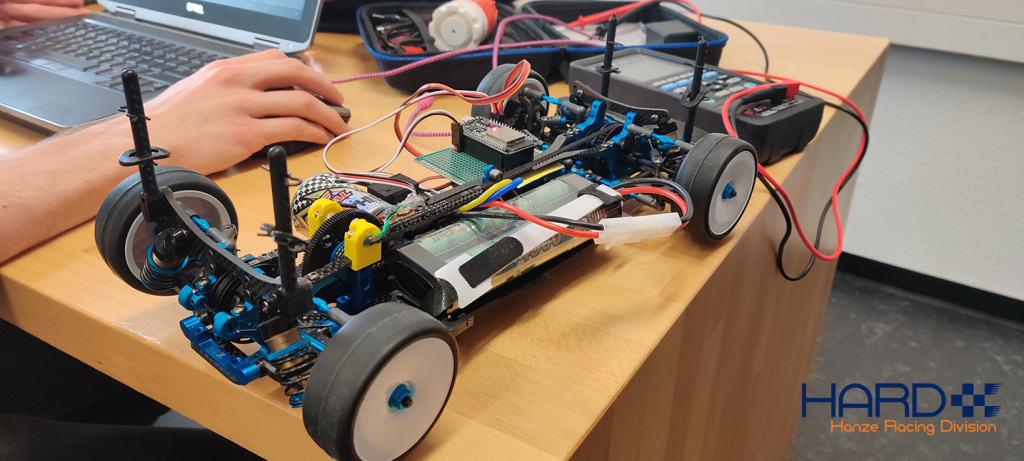
While a majority of HARD members work on the current version of our first electric car, the HRD05, some are propelling themselves into the future, creating the systems that will one day drive our babies. They are the Driverless Team, a group of passionate programmers, mathematicians and excel sheet lovers on a route towards making fully autonomous cars a reality. Their journey starts with the creation of a programme that will not only drive the car, but also recognise a circuit and map it. This is done using the well known Python programming language and combining it with cubic splines functions, which joins given points and creates curves that the car will use to guide itself. This is then tested on the computer using a virtual car, which you can see for yourself here under ! https://youtu.be/jjkVcTA4JXI Virtual car driving autonomously in simulation The programme is then uploaded into a remote controlled car and tested thoroughly. The system needs to recognize the cones that make up the track, and follow them with precision. However, a clear difference between the virtual and the remote controlled car’s behaviour is expected, as the physical car is subject to lots of environmental factors that are not present in the simulation, such as wind or bumps in the road for example. To limit these behavioural differences, a system called SLAM is used on the virtual car, simulating environmental factors in an attempt to programme the car’s reaction before sending it on the tarmac. Remote controlled car used for tests
A glimpse into HARD’s electrical department

Today we briefly dive into our electrical department with an interview of two members: Thanos, at HARD since this summer, and Mert, member since November. Both of them study Sensor Technology at the Hanze University of Applied Sciences, and are eager to learn and take up challenges. Thanos Mert Having joined the team nearly a semester ago, Thanos had the chance to work on numerous projects, including the RTDS and the wiring of PCBs to one-another. The RTDS is a loud sound indicating the start of the electric car, thereby replacing the usual sound of a combustion motor being turned on. This is needed to prevent the nearby personnel from touching dangerous parts of the car when it is under tension, as doing so could result in serious injuries. In addition to that, other safety features, consisting of lights, sounds and physical protection, are also integrated into the car in order to prevent accidents from happening. “HARD is like a baby to me” When joining the team, he first experienced a joy that he likes to compare as having a baby. As time passes, it (the baby) grows, and you grow with it. You encounter problems that you don’t fully understand, and you need to learn how to solve them by yourself. However, the rest of the team is always here to help, and you can count on them to not only solve the problem, but also to learn from it and pass it on when the time comes. On this point, Mert agrees totally, and shares that he got help from numerous members to develop his first PCB, which is is very proud of. Some PCBs in a box, waiting to be connected to each other “Everyone here is passionate about what they do” Mert didn’t expect it to be easy, but he loves the challenge and, up until now, HARD has lived up to it. He can learn more than he does in his programme, without having to invest too much of his time, which he wants to spare for his exams. This gives him confidence that he will find a job he loves later on, should it be at one of HARD’s partners or something else.